Celestial experiences

When I was seventeen, my first journey without my parents led me to North Africa – specifically to Morocco. I went there by train with one of my school friends. On a very hot summer day, we explored the city of Meknes in the north of Morocco, and our long walk ended in the slums. Houses there were made of planks crudely hammered together and plastic bags. I was really shocked and sad as I saw that human beings had to live in such poverty. Born in Germany, I had never seen anything like that before.

After my return to Germany, the sympathy I felt urged me to join a humanitarian aid group and Amnesty International. I read a lot about all the hunger in the world, the wars, the torture, the ecological disasters. Such an unjust world, full of suffering! I intensely looked for ways to change the world for the better. God provided me with a clear mind and the ability to understand that power can change situations for a while, but that real and lasting change will start only when human beings feel more sympathy and love in their hearts and start to share. But how could I help to bring about this change?

After I had finished school, I moved with a friend to an old farmhouse where we grew organic vegetables in the garden and I started my civilian service. I did not want to join the army and chose instead to serve disabled children. One Sunday I went to a market where I saw a poster announcing a movie about Zen meditation, which was to start in a few minutes in a tent on the market. I entered the tent and watched the movie. All of a sudden the whole world around me changed. I was so happy, and everything around me seemed so beautiful. Unfortunately this lasted for only a few minutes.

I had a similar celestial experience out of the blue a few weeks later, when I looked at some tropical plants in a hospital as I brought one of the disabled children there. This inspired me to practice Zen meditation. I also practised Hatha Yoga and read Yogananda’s Autobiography of a Yogi. One day Peter, a participant in the Hatha Yoga class I attended, put a brochure in my hand saying something like, 'This is about a real spiritual Master.' I was looking for a real Master of meditation who could teach me, because I was unable to get this celestial feeling again through my regular Zen meditation practice.

A few months later, I met the spiritual Master Sri Chinmoy, whom I had read about in the brochure. While shopping in Munich, I saw a poster that announced a Peace Concert by Sri Chinmoy. I drove there with three members of our flat-sharing community at the old farmhouse. Sri Chinmoy played many instruments at the Circus Krone in Munich, but I did not have any inner experience. For some reason, I decided to sign up for a meditation class given by Sri Chinmoy’s students in Munich.

Nine months later, I moved to Munich to study homeopathy, acupuncture and a few other alternative healing methods. I attended the meditation class and learned a lot, but the celestial feeling did not come back. At the end of the class I was asked if I wanted to become Sri Chinmoy’s student. I was not sure because I had had no significant meditation experiences during the class. Therefore I decided to go by train to Florence, where Sri Chinmoy would offer another Peace Concert in a few days.

The moment I arrived in Florence, I was very happy, even though I was quite tired because I had not been able to sleep well in the coach section of the night train. I was asked to give a photograph and a completed questionnaire to Nivedak, one of Sri Chinmoy’s students, in case I wanted to become a student. I gave Nivedak both even before I had listened to Sri Chinmoy’s performance! I felt that Nivedak’s big heart and my happiness inspired me to act immediately. I decided to stay a few days longer in Florence to enjoy the springtime, because I was so happy there. But the next day, my happiness had disappeared. I realised that the reason for my happiness had been Sri Chinmoy’s inner and outer presence and not the springtime.

A few days later, just before leaving for Oslo, Sri Chinmoy accepted me as his student. I meditated very regularly and my general mood moved in a positive direction, but I did not have my celestial experience again. Was my choice wrong?

In April 1989, a year later, I stood beside the entrance to a hall with many tropical plants in the Hilton Hotel in Munich. Sri Chinmoy was there to meet and honour a Nobel Laureate in Physics. Suddenly Sri Chinmoy approached me as he went to welcome the Nobel Laureate, who was standing quite close to me. Sri Chinmoy looked briefly into my eyes. My consciousness changed. I felt deep inner peace and everything around me looked beautiful. The celestial feeling I had experienced was there again! This time it lasted for hours. From that day on, I was sure I had found the right person to lead me to enlightenment.

A Flame in my Heart

My real spiritual awakening I owe to my father, who gave me Hermann Hesse’s book Siddharta to read when I was 15. This is the story of a Brahmin boy in India who leaves his home, joins a group of ascetics and lives in the desert. He meets Lord Buddha but is not satisfied with Lord Buddha’s path. Finally, he finds his Guru and realises God. When I read that book, I immediately knew that my life would be a spiritual quest. I read the Koran, the Bible and books about Buddhism – but for me the most striking book was the Bhagavad Gita. This book I read over and over again.

When I was between 18 and 22, I tried to meditate and juggled a little with trying to develop occult power. Most importantly, I came across Indian classical music. In 1976, my wife Ajita and I made a five-week trip to India, visiting several Ashrams with the hope of finding our Guru. We went to Rishikesh and to the Ramana Maharshi Ashram in South India. Our last stop was the Sri Aurobindo Ashram in Pondicherry. We could not enter the Ashram but were told to go to Auroville, which is about 7 kilometres outside Pondicherry. There we slept in a straw hut with rats running about in the roof, looking down at us during the night. The next day we fled from the place and went back to Delhi, where I decided to become a music teacher. I felt some kind of power inside myself and had the urge to give something to humanity.

In Delhi we visited a music store, where I held a sitar in my hands for the first time. The touch and vibration of the instrument affected me deeply, and I decided that I had to learn this instrument. A few months later, back in Switzerland, Pandit Ravi Shankar gave a concert in my home town. I had my first spiritual experience during this concert. As we were leaving the concert hall, we met Abarita, who was outside distributing leaflets for a meditation class, which Ajita and I attended.

Abarita showed a film of Sri Chinmoy in samadhi1 and talked about meditation and Indian culture. I felt that I knew more about Indian culture than Abarita because I had visited India a few months earlier, whereas Abarita had never gone to India. So my pride came to the fore, not allowing me to see and feel Guru’s light. Nevertheless, we went to the Sri Chinmoy Centre in Zurich for a meditation. There we saw Guru’s Transcendental meditation photograph2, but nobody explained anything, and there were no books, nothing. I looked at the Transcendental photograph but did not understand what it was all about. So we did not become Guru’s disciples at that time.

During the year 1977, I was torn with the desire to have a spiritual Master but with no idea of how to find one. At the same time I bought my first sitar and felt tremendous joy in experimenting with the instrument. Ajita and I decided to go to India to learn Indian classical music, with the intention of realising God through music. Then we were unable to get visas for India, so we decided to go to Sri Lanka.

In December 1977, we flew to Sri Lanka to learn Indian classical music from the best musician in the country for the next four years. In the beginning I still had my God-realisation in mind, but as I became more and more absorbed in the process of studying and practising music for many, many hours each day, I forgot about my spiritual search.

After four years, I realised that I would never be able to really play Indian classical music, and that I would just be fooling both the audience and myself if I were to announce myself as an Indian musician back in Europe. So we stopped studying music and started a programme of social education in Switzerland to address the heart-wrenching poverty that we had seen in both Sri Lanka and India. We  wanted to go back to India one day to start an orphanage. The programme that Ajita and I started was a very good medium for self-knowledge and self-discovery. My inner urge for a higher life had once again been awakened, and I felt that "the real thing" was still missing from my life. My brother-in-law had had a Master for several years, and since I did not know of anybody else and was desperately in need of a spiritual Master, I wrote to his Master and applied to become his disciple. On his path, the diet is very strict; his students have to avoid not only meat and fish but also eggs.

Having been vegetarian already for many years, this did not seem to be a problem for me. However, because I was working and partly living in a home for deprived children, I wrote on my application that, due to my job, it would be too difficult to avoid eggs completely. I received the reply that I would not be accepted if I continued to eat eggs. I was desperate.

To complete my three years of music school, I was required to write a thesis. The subject of my thesis was music therapy using the tamboura, an Indian instrument. I wanted to try this therapy with one of the children in the home for deprived children where I worked, but I had no instrument. It was now 1986, 10 years after meeting Abarita outside Ravi Shankar’s concert. I remembered that Abarita was dealing with Indian instruments, so I called him and asked whether he had a tamboura for me to buy. In the meantime, Abarita had set up his tofu factory and no longer had anything to do with Indian instruments. But he gave me the phone number of someone in Madal Bal, who agreed to purchase a tamboura for me. I was to pick it up from the Madal Bal health food store in Zurich

On this day, 2 January 1987, Ajita and I were still living in Appenzell, about 100 km away from Zurich. Our whole family, with Anupama, two years old, and Bandhavi, six months old, travelled by train to Zurich to visit the shop at Kreuzplatz. Gunthita was working in the shop. The tamboura was sitting there in one corner. I picked up the instrument and tried to tune it, but somehow I was not able to. I wondered what possibly could be wrong, as tuning the tamboura should not have been a problem for me. However, I simply could not tune it. I thought, well and good, let’s do it the Indian way and give it a little time. So I placed the tamboura back in the corner and looked around the tiny shop.

There were many pictures of Sri Chinmoy, but one picture immediately struck me. Guru looked so happy in this picture and immediately made me jealous. Here was definitely somebody who had really found his goal, who was satisfaction incarnate. And I was not!

A recording of Gunthita’s music group (named Fountain-Light at that time) was playing in the shop. I went back to the tamboura, and lo and behold, it was in tune. It was in tune exactly with the music that was playing. At that point I knew something was happening. I remember looking deep into Gunthita’s eyes, searching for something special. But she just looked back at me with her open, cheerful eyes. I remember also buying one of the books that were for sale. The most important thing was that I felt Guru’s light in my heart like a tiny candle flame – it was such a nice, warm, loving feeling.

Before leaving the shop with the tamboura, I asked Gunthita how to become Guru’s disciple. She explained that we would have to send in our photos with an application. After leaving the shop, Guru’s flame in my heart kept on burning. When I returned home, I sent my picture and application, and about a month later, I got a call saying that I was accepted as Guru’s disciple.
  • 1. A high state of awareness where one is identified with the Universal Consciousness.
  • 2. A photograph of Sri Chinmoy in the highest consciousness which his students use for meditation.

A Quest for Happiness

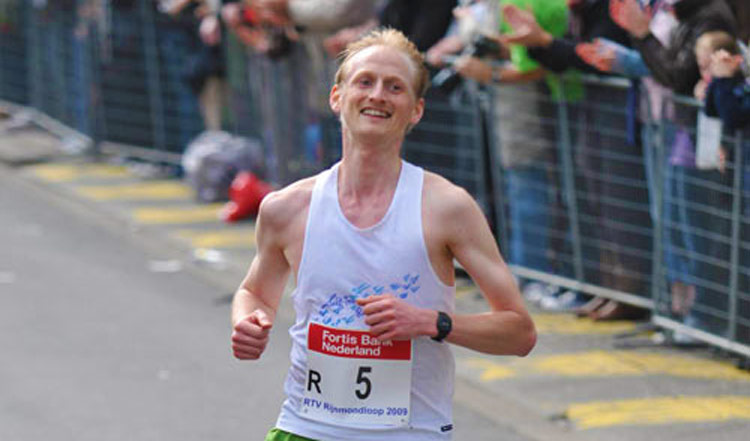
Abhinabha is a very good athlete; his marathon best time is 2:27

The spiritual life is a quest for happiness. From early childhood on, I was convinced that happiness is the meaning and purpose of life. Over the years that deep-rooted conviction has remained my raison d’être. To be happy or not to be happy, that is the question.

One day, when I was nineteen years old, I discovered that I was no longer happy. It was a revealing and somewhat shocking discovery. The childhood that was behind me had been full of happiness. I had been a lucky kid: plenty of friends, loving parents, a happy childhood. And even in my later teen years, you could say I was fortunate. I studied theatre sciences, which was something I loved, and I lived in Amsterdam, an exciting and 'happening' place. All the ingredients for a happy life were there, you might say. Yet I was not really happy.

There was a persistent superficiality about my life, which I was dreading more with every passing day. Conversations were always about the same kind of topics. Life revolved around studying, going to the theatre and hanging out in bars to talk and drink. I felt like a record playing the same tune over and over again. I was definitely missing something, although I couldn’t really put my finger on it. I guess I hungered for more profundity – a richer satisfaction than could be scraped from the daily grind of student life.

But what it was and how it could be found I had no idea. To quote Hamlet, I felt there was 'more between Heaven and earth' than most people cared for. I guess you could say I was spiritually hungry. At the time I was already meditating, just by myself. It was nice, but nothing special. My meditation practice was very separate from my daily dealings at the university.

It was during this period that I attended a lecture given by the Sri Chinmoy Centre in Amsterdam. How I got to the lecture in the first place is a funny story. At the university I had heard about an Indian guru who was supposed to give a lecture in a wellknown church. It triggered some inner response in me. I decided to go. The lecture started at 7 p.m., but for some reason I could not find the intended church, which was really weird because I was sure I had seen it many times.

It was already past seven, when a tiny poster caught my attention. The poster was hanging at the gate of a city park. On it was a small picture of a friendly Indian man and an aphorism about inner peace. The name underneath the picture read 'Sri Chinmoy'. It advertised a meditation lecture, but not the one I had planned to go to. I looked at the information underneath. This other lecture was starting that very evening at 7:30 p.m. The venue was nearby. 'All right, then let me just go there', I thought. I jumped on my bike and arrived well in time for the lecture to start. Bull’s eye – really one of life’s 'planned coincidences'. I sat there and drank it all in. That lecture changed my life.

The speaker was a man of about 40 years old, exuding some inner poise. He talked about an inner, spiritual life, about peace, love and happiness and how to bring these inner realities in ourselves to the fore through meditation. He was very inspired and very nice. His voice had a lot of kindness and love to it. What he said was like music to my ears. I left the lecture feeling a deep sense of peace and a joyful, exuberant feeling in my heart. I had found what I had really been looking for! It was as if a curtain was drawn from my eyes and suddenly there was this beautiful and greater view of life. It had somehow been waiting for me. It felt totally natural and 'right'.

For a couple of months I followed the meditation class offered by the Sri Chinmoy Centre. Gradually I became more inspired and enthusiastic about Sri Chinmoy’s philosophy. What really appealed to me was the combination of a profound and soulful inner life with a dynamic and versatile outer life.

But I also had my doubts. Becoming Sri Chinmoy’s disciple also meant giving up some of life’s pleasures. I was 20 years old at the time. Was I ready to become a spiritual person, a modern monk so to speak? The largest part of me was telling me to jump into the spiritual life, but a more conservative part was still holding me back.

It took me a long time to decide – I think I followed the beginner’s course for four months. And I would have lingered on even longer if it weren’t for two dreams I had that featured Guru. In the first dream, Guru was teaching songs to a group of his disciples, and I was also among them. In the second dream, Guru was in a Dutch town called Leiden, but in my dream it was spelled 'Lijden', which is the Dutch word for suffering. It was totally symbolic. Guru was there, and I remember he shook my hand and smiled at me, as if to say, 'I can take all of your suffering away.' When I woke up I felt a very spiritual energy and I knew I had to become Guru’s disciple. So I did. It turned out to be the best decision of my life. I have not regretted it for a moment.

I am extremely grateful to Sri Chinmoy for giving me the opportunity to discover the spiritual life. His loving inner and outer guidance have brought me many treasures and have given my life a purpose that colours my days with joy and satisfaction.

Is it unspiritual to care about winning?

Spiritual philosophy teaches us to be detached from the result of our actions. Sri Chinmoy writes that the right attitude is to take victory and defeat in the same spirit.

“Who is the winner? Not he who wins, but he who has established his cheerful oneness with the result, which is an experience in the form of failure or success, a journey forward or a journey backward.”

Sri Chinmoy1

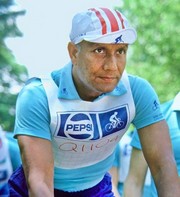
When racing I try to bear this in mind. But, as well as taking victory or defeat in the right spirit, I still like very much to win. I feel the secret is to concentrate on your own performance – to race to your potential, to strive for greater efforts and speed and not worry about others. If we are competing with ourselves, then it is a spiritual discipline. If we are only concerned about winning, we start focusing on other competitors and just try to beat them. In a way this dissipates our energy because we are worrying about others getting faster, etc.

500-img_0001.jpg

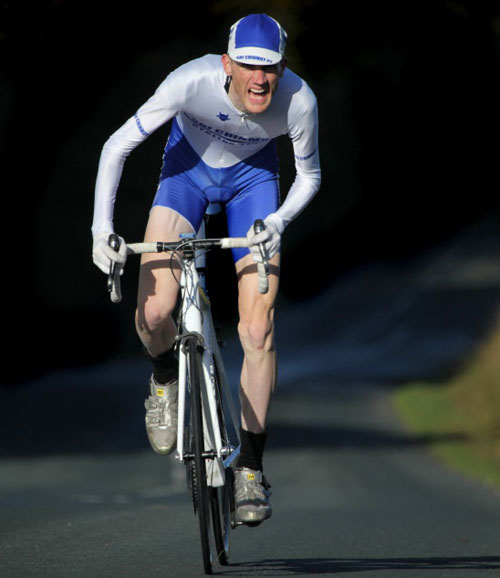
In racing, mental preparation also plays a key role. The first step is to concentrate on a positive visualisation of doing well. This is not a visualisation of seeing yourself at the top of the results board, but a visualisation of doing the best possible race. When racing, it is also very important to have the right motivation, enthusiasm and concentration.  When racing, as much as possible, I try to keep the mind quiet and blank. In a short intense race, such as a hill climb, this is quite possible. It is a very striking experience when the body is numb with pain, fighting every signal to slow down, and you are just experiencing this mixture of sensation and mental quiet. The effort needs to be so intense that thinking random thoughts feels as if you are dissipating your precious energy.

When you can race at that intensity, being completely detached from thoughts, you feel you are giving your best performance. Some of my most disappointing results come when the mind gets distracted and I start thinking and doubting myself.

I wouldn’t say racing with a clear mind is like meditation. There is a great pain in the body and part of you is screaming for it to end, but it feels that with a silent mind you can maximise your limited energy; it also feels an exhilarating experience – at least when you collapse over the finish line.

For longer races, keeping a completely quiet mind is not possible. In long time trials, e.g. 100 mile TT, it becomes quite easy for the mind to start wandering. In these kinds of races, I may inwardly repeat a mantra (sacred word) or concentrate on visualisation techniques.

On one of the few occasions Sri Chinmoy spoke to me, it was about cycling. He took an interest in my races and liked to see the results of the races I did.

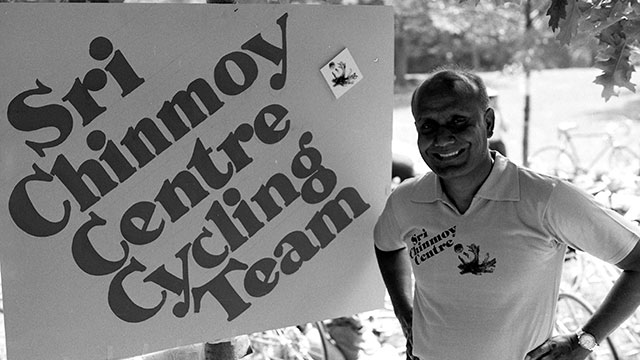
Sri Chinmoy competes in the 1979 24 hour race

Sri Chinmoy was involved in so many multifarious activities during his 76 years on earth, that it is perhaps not surprising that he also tried his hand at cycling. In the 1970s, Sri Chinmoy and other members of the Sri Chinmoy Centre took part in a 24-hour cycle race around Central Park, New York. For a few weeks before the race, Guru would go with disciples to practise cycling in Flushing Meadows Park. Being relatively untrained, he didn’t find cycling easy, but with great determination he completed three 24-hour races. After his last cycling 24-hour race in 1979, Guru increasingly focused on long-distance running, completing several marathons and ultra-marathons.

In one sense, Guru didn’t have to be involved in so many different activities. But, I feel he was trying to show that spirituality could be applied to any aspect of life. It was certainly inspiring to know Guru had tried cycling with great enthusiasm. 

My Life with Sri Chinmoy: a book

tejvan-26.jpgThis is an account of why I became a disciple of my Guru, Sri Chinmoy, and also some of my experiences from following a spiritual life.
It is very much a personal perspective and only a partial insight into the teachings and life of Sri Chinmoy. But hopefully some of the themes expressed in this book will sound familiar to those treading their own spiritual path.

Sweet moments with Sri Chinmoy

We Know How to Serve

by Sanjay Rawal, New York, USA

sanjay.jpgLast weekend, one of Sri Chinmoy's friends was in a city very near to one which has a large meditation center. A few of Sri Chinmoy's students took him and his family to the airport for their morning flight. After affectionate goodbyes, they departed.
World Harmony Run in Vietnam

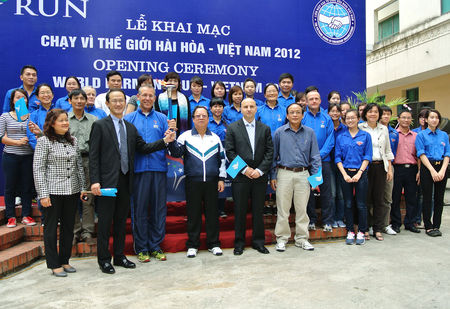
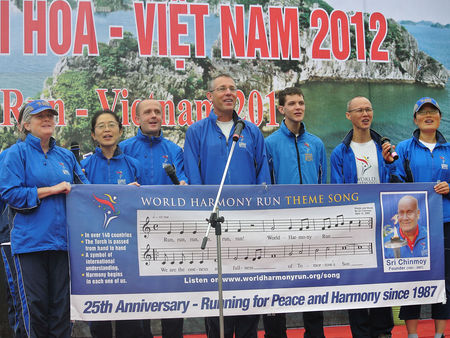
The World Harmony Run recently visited Vietnam and was enthusiastically welcomed by the local population.  This unique run for world peace was founded by Sri Chinmoy in 1987 and, in the past two decades has captured the imagination of thousands of people across the world.

The World Harmony Run in Hanoi. Invited guests and members of VUFO youth organization join in holding the peace torch.

whr-vietnam

Members of the World Harmony Run in Ha Long Bay, Quang Ninh Province.

The oneness of all paths - personal experiences

Some personal experiences of the oneness of all paths and other interfaith activities of the Sri Chinmoy Centre.


pradhan.jpgPradhan Balter
Chicago

Songs of the Soul: Hungarian concert tour

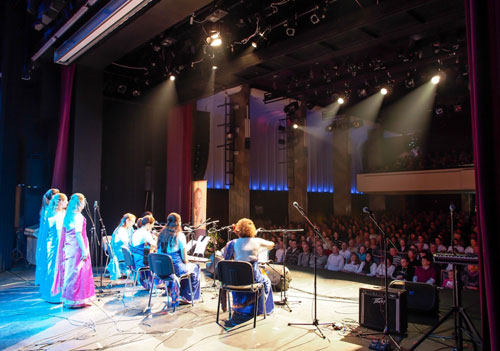
Recently, four concerts took place in the Hungarian cities of Budapest and Szeged, featuring music from a variety of musicians within the Sri Chinmoy Centre performing arrangements from the music of Sri Chinmoy.

concert

Performers playing to a packed crowd in Budapest.

sots2012-3

The concert was inspired by the musical legacy of Maestro Sri Chinmoy.

Samunnati Wins Toulouse International Marathon

Samunnati Nataliya Lehonkova of the Sri Chinmoy Marathon Team won the Toulouse International Marathon in France on October 29th. Amidst extreme weather conditions including a temperature of 3 degrees Celsius, she set a new personal best in a time of 2.38:22.

Samunnati hails from Ukraine and is the fastest female runner in the international Sri Chinmoy Centres. Earlier this year she won the marathon in Edinburgh, Scotland. When running she tries to invoke spiritual energy to help her in the race. Samunnati says she is inspired by Sri Chinmoy's deep love of running.

Pages